Showing posts with label Belfast Girls. Show all posts

Thursday, 19 September 2013

The fantastic Frank McGrath CUTs to the chase!


It's the turn of one my 'new discoveries' to feature on the blog. Last time I wrote about an 'old favourite', Modesty Blaise. This time I have a really exciting new writer for you.

More than three years ago I came across a great writer on the Harper Collins slush pile site, Authonomy – Frank McGrath from Dublin. His book was at that time called Artistic Licence (a very clever name, I thought – cleverness in a title always appeals to me) and I was hugely impressed by it. I particularly liked his cop character, Jack Grogan. Just my sort of flawed, independent hero.

I became a 'virtual' friend of Frank, but alas he disappeared from Authonomy when (no surprise) his book was picked up by an established agent, and he was told to pull it and make a ton of suggested edits. It seemed like a great step forward for him.

But I was annoyed at the suggested edits, particularly the criticisms of the lead character – I thought the book was great as it was. And as several years went on, and I reached the top 5 on Authonomy; was offered a publishing deal for Belfast Girls by Night Publishing; and went on to sell well over 20,000 of that particular book (and still counting), I seriously wondered if Frank was doing the right thing.

In late July this year his book was finally published, and I humbly take it all back. This was a very good book – now it's a great one.


Frank McGrath now ranks among my really favourite authors, and I'm looking forward eagerly to his next book.  It's not many of the new writers I can say that about, I'll admit, but Frank stands out, as he did on Authonomy, head and shoulders above most of the rest.

Apparently one of the major editing suggestions made was that he should split the book into two, with a separate story about the villain . This must have been extremely difficult since, as I remember it, in the first version the two characters and their stories were intricately linked.


Frank tells me,

 'The key problem I had was to separate the bad boy character at the start of the old "Artistic Licence" into his own story…. which is done. Here's the pitch:
"BAD

Meet Daniel Hennessy: artist, mental patient, sociopath. 
Released on compassionate grounds due to terminal illness, Danny has one last mission to perform."

That should go on Amazon on a few months.'
Sounds fascinating, Frank.

But to return to CUT (another very clever title, as you'll see when you read it).

The blurb on Amazon is this:

A savage killing. A girl missing. A clock ticking.

A cop who sees the world differently.
Detective Jack Grogan investigates the disappearance of the Chinese Trade Minister’s 15 year old daughter, following the brutal murder of her bodyguard.
He soon discovers that Lynsey Tao is a pawn in a game where no one can be trusted and nothing is what it seems.

Sounds good, right?

And my own review reads:


I've just finished reading CUT by Frank McGrath and I'm still breathless.

This, as other reviewers have said, is a fast moving book which grips you by the throat from the first page and refuses to let you go. To me it was like reading my first Ruth Rendell, Ian Rankin, or Sara Paretsky. I knew at once I had found a new writer whose books I was going to love right through everything he wrote. A book full of grit, focussing on the dark side, but with characters to love and rejoice in, and with the sort of depth and philosophy which can't be forgotten.

Superintendent Jack Grogan is a flawed but fascinating character, one I'm determined there should be more of. Jack makes his own rules, and this naturally leads him into trouble, but his brilliance carries him through bad times as well as good. His life hasn't been easy. His separation from his wife, the death of his young son - these are the sort of things, together with Jack's subtly conveyed feelings about them, which draw us ever deeper into the book.

McGrath's style is an added bonus. His images and descriptions bring his scenes alive. For instance, 'The marble fireplace was big enough for Santa to enter and exit without having to crouch.' (This at Christmas time, so especially striking.)

Like all good detective stories, CUT twists and turns, with suspect after suspect emerging, and the ending (which will shock you) has not one but three twists, following fast on each other's heels.

Frank McGrath, we want more! When's the next Jack Grogan book coming?

Really highly recommended.

As you can see, I'm pushing this book as hard as I can!
You can buy CUT on Amazon (for only 77p / 99c) at: 

And hey, let's not forget, you can buy my own books at these links:


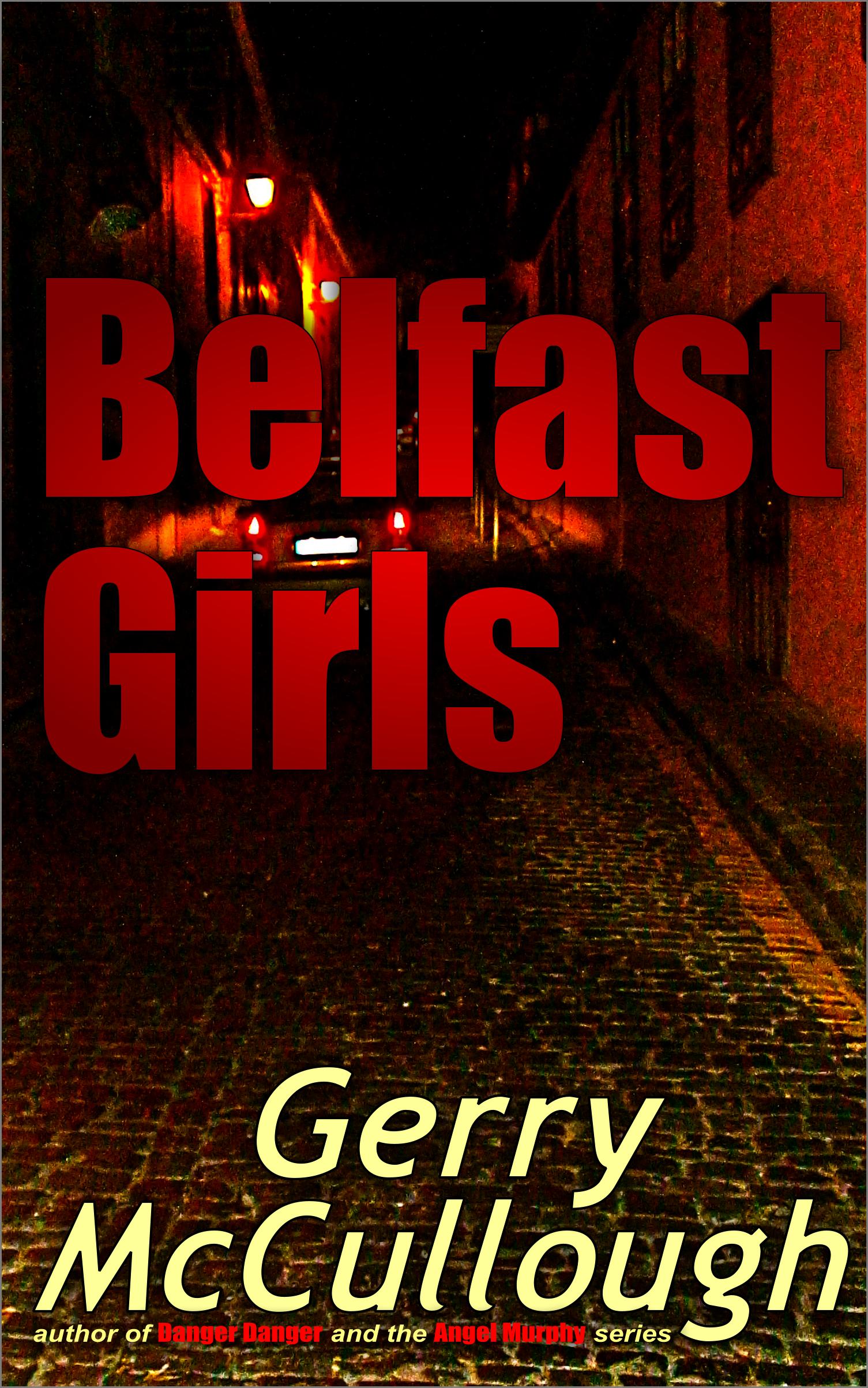
Belfast Girls 


Danger Danger


Angel in Flight: the First Angel Murphy Thriller


The Seanachie: Tales of Old Seamus


Lady Molly And The Snapper


And finally, my new release, Angel in Belfast: the 2nd Angel Murphy Thriller about the feisty young Belfast girl!


Why not try them?

Goodbye and God Bless! See you soon!


Tuesday, 2 July 2013

The Saint and Leslie Chartertis

The Saint

For various reasons – a long drawn out bout of bronchitis which knocked me offline for a couple of months, followed by the serious need to finish and publish my latest book Angel in Belfast: the 2nd Angel Murphy Thriller – I haven't written this blog for several months.

What seems like a very long time ago (okay – it was February!) I said that my next  'Old Favourites' post would be about the Saint. Leslie Charteris, the author of the amazingly best selling Saint books (I don't have up to date records, but one of my old paperbacks, last republished in 1964, tells me the number was over 22 million then, and counting!) is a very undervalued man. I love his books, and so, obviously, do millions of others. He was a clever man (educated at Oxford) and a clever writer, and he invented a character who will live as long as people enjoy reading.

I had read a few of the later Saint short stories in various magazines before I really began to make his acquaintance. This happened because I'd been taken by a former boyfriend to visit an elderly, retired man– as a sort of good work. The thought was, that he was probably lonely and would enjoy being visited. Well, he did appear to like our company.

This man seemed to me to have the ideal life style. He lived alone, and spent his time visiting the local library, reading the books he'd picked up there, and then going back for more. What bliss! He liked to talk to me about the books he was reading, and on one occasion he pressed upon me a couple of Saint books he wanted to give away (to leave space in his small bungalow for others). I wasn't specially keen on the Saint at that time, but I accepted the books in order not to hurt his feelings.

In fact I quite enjoyed them, and over the years I picked up more than a few second hand, until I had a good representative collection of them.

But it's only in the last dozen years, when I began to order the earlier books from Amazon (also second hand), that my enthusiasm took off.

Here is a character whose roots go back to Robin Hood. More recently, he descends from Raffles (who is mentioned in several of the Saint books) and Bulldog Drummond. He is the archetypal highwayman, pirate or buccaneer. The epitome of the adventurer, the swashbuckling hero, beloved by every schoolboy – and, may I point out, by every schoolgirl!

And as for his influence, that goes on down through James Bond, Modesty Blaise and Lara Croft to my own Angel Murphy!

Amazingly enough, although the Saint has frequently been portrayed on TV and in film, no one has ever come close to really representing the character as he was written. I suppose Roger Moore came closest. But he didn't really look the part – and he was too lacking in that je ne sais quoi, that impudent daring, which epitomises the Saint. Roger Moore played him as too nice. I suppose I'm asking for the impossible. But maybe Martin Kemp?

Recently I watched some of the early black and white Saint films on iPlayer and enjoyed them, but again, none of the actors came near to being the Saint. George Sanders certainly got the character across – but, for goodness sake, Simon's slim leanness is empathised over and over again! Not GeorgeSanders!

But one thing I can thank these black and white films for was the opportunity to watch The Saint Meets The Tiger – the very first Saint full length story. (Alas, the book is out of print now, and is only available second hand for telephone numbers. Much as I'd love to read it, not at several hundred pounds!)

Because it's the very early Saint books which kindled my enthusiasm.

The Last Hero is a brilliant book in every way. So is The Avenging Saint, Enter the Saint, Featuring the Saint and The Saint's Getaway. In these, Simon emerges as a man with vision and ideals, not afraid to fight for the justice he believes in. A man 'born with the sound of trumpets in his ears.'

Leslie Charteris writes in a fine, impressive style. And here may I digress to say that, although I sort of admire Hemingway (my favourite of his books is The Sun Also Rises) I believe he – or actually his admirers – have done an amazing amount of damage to writers of English. The clean, sparse style has something to be said for it, okay. But surely we are missing so much by writing off the more elaborate, poetic style of writing? It's like the difference between the Classic style of architecture and the elaborate Byzantine style. Personally I like both. And why not?

Leslie Charteris is not afraid to be romantic, to portray love as an ideal, to give his hero the sort of feelings, the desire for justice, the desire to right wrongs, which motivated the Knights of the Round Table. Simon says, in The Last Hero, that the last thing he wants is to be delivered from 'battle, murder and sudden death,' for these are the spice of life. He is brave, witty and intelligent, and his adventures show him demonstrating all these characteristics.

Like Modesty Blaise's Willie Garvin, he uses a knife rather than a gun, A knife which he calls Anna and which he wears hidden up one sleeve. This allows him more than once to cut his ropes when the villain has tied him up. However, Chatreris doesn't let this ploy grow stale. Comes a day – quite early on in the Saga – in Enter the Saint, when he is tied up too firmly to get hold of the knife. And then it's left to his wits to save him – which they do.

In these early books Simon is surrounded by some excellent minor characters, and their reality adds a lot to the pleasure. There is Patricia Holm, whom Simon loves, and who is not the typical girlfriend of the time. Bulldog Drummond has a girlfriend (later wife) called Phyllis, who allows him to pat her on the head and say, 'Go to bed, little girl. This is my business!' before dealing with the villains. Patricia would never have let this happen. Simon tells us, in The Avenging Saint, one of the reasons why he loves her. Speaking about Sonia, another girl whom he had found attractive, but who let him get caught by hesitating to shoot at the right moment, he says, 'Pat wouldn't have missed that chance.'

Then there's Roger Conway, the Saint's best friend and lieutenant, whose catch phrase is, 'You can always leave these little things to me,' whether it's rescuing Simon from inevitable death or simply trailing one of the villains. (Simon's own catch phrase at this stage is 'As the actress said to the bishop.' Lines such as, 'I'm always willing to oblige you, as the actress said to the bishop.' Later he dropped this. I suppose by then Charteris thought it was overworked.)

And there's Norman Kent, who also hears the sound of trumpets in his ears at the end of The Last Hero, and lays down his life for the peace of the world. In these early books, the first world war, which was still too close in the recent past to be forgotten, and the threat of the next, loom large.

(I don't know why I keep calling these guys 'the villains.' Charteris's own name for them is 'the ungodly' – a much better way of saying the same thing.)

Alas, as the books move on, Simon's helpers are one by one married or killed off. For a while he has Hoppy Uniatz, not a character I ever took to, and then in the later stories he works on his own. A pity, I think. Patricia Holm fades out, too. I suppose Charteris wanted to keep Simon foot loose and fancy free. Also a pity.

The  earlier books are mostly full length, but after the establishment of The Saint Magazine, Charteris wrote a short story for this every month, and these were collected up into books. Some of them were excellent, but writing to a formula never makes for the best work.

In his middle period, Charteris let his delight in style, in playing with words, run riot. In Call For The Saint, for instance, published in 1948, when dealing with a boxing match in The Masked Angel, he uses no less than three expressions for boxing matches or the boxing ring within a few pages  –  'the soiree of sock,' the 'mitt minuet,' 'the punch podium.' If he'd been writing now, I wonder if he'd have called his boxer hero 'the Lord of the Ring'? He also makes Simon respond to a cliche with the comment, 'To corn a phrase.' You either love this or hate it. Count me in with the lovers!

Later on, Charteris dropped this style and showed us that he could produce the clean, crisp type of writing as well as anyone. He had, it seems, been widely and destructively criticised for his middle period writing by those who set themselves up as experts, who have little or no sense of humour, and who have no delight in playing with words.  What a shame!

I love Leslie Charteris's Saint, and I'm not ashamed to say so!


Meanwhile, if you haven't seen any of my own books, they're growing in number. Starting with Belfast Girls,


the next is Danger Danger,


And then Angel in Flight, my first Angel Murphy Thriller.


I've also had The Seanachie, a collection of short stories, published


and Lady Molly and The Snapper, a young people's book,


before coming up to modern times with the publication of my second Angel Murphy book Angel in Belfast, just the other day.


Why not try some of them, if you haven't already done so? You never know! You might like them!

My next post (which will appear rather more quickly than this one did!) will feature a new discovery, Juliet Madison, and her crime book Second Chances: A DI Frank Lyle mystery. So there's something to look forward to!

Goodbye for now, and God Bless!

Links for my books:


http://www.amazon.com/Belfast-Girls/dp/B008J4NISK


 http://www.amazon.com/Danger-Gerry-McCullough/dp/0952578530


http://www.amazon.com/Angel-Belfast-thriller-thrillers-ebook/dp/B00DNL5VDE


Wednesday, 21 December 2011

The Lord of the Rings – Britain's favourite book – and mine.

Lord of the Rings

A few years ago, BBC2 ran a survey called The Big Read, where viewers were asked, first of all, to nominate their favourite books. Out of this, 100 top favourites were chosen. The next stage was a vote to select a top ten, and after that, with various celebrities speaking week by week in favour of one of these ten books, a final vote for the winner. I was torn in two, because several of my favourite books were in there with a chance.

JRR Tolkien in 1916
At the end, Jane Austen’s Pride and Prejudice and Tolkien’s The Lord of the Rings were level pegging, and I found it very hard to make my mind up which to vote for. In the end, I went for The Lord of the Rings, and as it turned out so did a substantial majority of other people, making it the nation’s favourite book at that time. No doubt the release of the first of Peter Jackson’s films, with the relevant publicity, helped, but it’s surprised me for years how many people, some of them very unlikely ones, love Tolkien’s masterpiece.

I suppose the best way to come to this book is after reading The Hobbit. However, like many others, I only heard of The Hobbit after I’d read the trilogy.  I was at university when a young and enthusiastic English lecturer started pushing The Lord of the Rings at me and my fellow students, telling us what a marvellous book it was, and that it had an enormous cult following. I borrowed it from the library, loved it, and a couple of years later, as a young married woman, managed to afford to buy the set while on holiday in a caravan in Portrush (a seaside resort not famed for its literary atmosphere, but with at least one bookshop at that time.) I’ve gone on reading it at regular intervals ever since, and have just finished the current re-reading. (Followed by The Hobbit.)

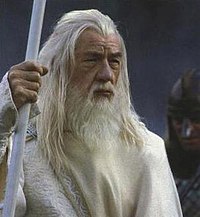
As always, I’ve been freshly amazed by how good this book is.  To me, the characters of the hobbits, and of Gandalf, and of Strider when we first meet him, are the main things which bring this story to life. The Shire, a version of England in the Middle Ages (but without the poverty and sickness and the dictatorial role of the upper classes) is such an attractive place; and the characters at this stage of the book are real people, whether or not they are labelled ‘hobbit’ ‘wizard’ or ‘man.’ Later in the book Tolkien introduces elves and so on who are far from human and if it were not for the earlier characters the trilogy would lose a great deal of the realism and believability which keep us reading on.  Merry and Pippin in particular are down-to-earth, likable and enjoyable characters, but so are Sam and Frodo until nearer the end. Gandalf develops into ‘The White Rider,’ and becomes less and less the Gandalf we know, cross, inclined to joke, and very much an individual.  Strider, a blunt, straight speaking stranger who may or may not be trustworthy, develops into Aragorn, the King, and becomes, like Gandalf, less real. But by then we are prepared to accept this sort of thing, and the ever present hobbits keep us pinned firmly down to earth, even if it is ‘Middle Earth.’

Don’t misunderstand me. One of the most attractive things about The Lord of the Rings is its atmosphere of poetry and magic, and the sense that we are living in a world of long ago.  But the down-to-earth hobbits (representatives of ourselves, whom we can relate to) are essential, to allow us to enjoy the rest of the environment.

It’s highly appropriate that the trilogy ends back in the Shire; and although Frodo can no longer live there, Sam can and does.

Always, I particularly enjoy the maps at the end of each of my three volumes. I constantly unfold them to check whereabouts the current action is taking place, and by the time I’ve finished the third book, I feel as if I know every inch of the ground which the travellers have covered, and am at home there in a way which is both satisfying and exciting.  Alas, some years ago the map from my first volume was first of all accidentally torn off, and then eventually lost. I feel bereft without that initial map, a close-up of the country covered in Volume 1, of the journey through the Shire, the time in the Old Forest and the Downs, the events at Bree, the attack on Weathertop, the Flight to the Ford, and the first part of the Nine Companions’ journey as they attempted to cross Caradhras.  The map in the second volume orients me from then on, but that initial part is sorely missed.

How many people, I wonder, avid fans of The Lord of the Rings, read it purely as an exciting adventure, and miss the inner meaning? The struggle of good against evil, the fact that even the good, like Boromir, may fall – this is probably clear enough to most. As John Bunyon said in The Pilgrim’s Progress, ‘Then saw I that there is a way to Hell, even from the gates of Heaven.’  Probably most readers pick this up without difficulty.

But the death and resurrection of Gandalf, who thereby is able to defeat the power of evil as portrayed in Sauron – do most readers understand the allegory set out in this event? I wonder.

I can’t finish writing about this marvellous book without quoting some of the poetry which adds so much to the magical ambience of the whole. Right at the beginning is one of the best examples:-
Three Rings for the Elven-kings under the sky
Seven for the Dwarf-lords in their halls of stone,
Nine for Mortal Men doomed to die,
One for the Dark Lord on his dark throne
In the Land of Morder where the Shadows lie.
One Ring to rule them all, One Ring to find them,
One Ring to bring them all and in the darkness bind them
In the Land of Mordor where the Shadows lie.

Like all good poetry, this says more than the simple words convey – it plunges us immediately into the atmosphere Tolkien wants us to feel.

Then there is Sam’s song in Book Three, another simple and beautiful poem, but this time conveying an atmosphere of hope and peace, ‘In Western lands beneath the Sun…’ and Frodo’s farewell to the Shire early in Book One, ‘The Road goes ever on and on…’  Everyone will have their own favourites, and I must stop quoting mine or, like the road, I might go on for ever.

I said last week that I hoped to have another post up before Christmas, and to my surprise, and probably to yours, I’ve succeeded in doing it.

Have a lovely time over the next week or so; and as Tiny Tim said, giving the toast at the Cratchett family’s Christmas dinner in Dickens’ A Christmas Carol, ‘God bless us everyone!’

(And if you are one of the millions who buy or are given a Kindle this Christmas, don’t forget to buy Belfast Girls,

and /or Danger Danger,


my two Irish romantic thrillers, to help you have a really great time – says she modestly.)

See you in the New Year.