Friday, 25 October 2013

Hazel Holt's Sympathetic Villains

Hazel Holt didn't write (or rather, publish – it isn't always the same thing) her first detective story until she was over sixty. So there's hope for us all!
Not that she'd been unpublished until then. As the Literary Executor for Barbara Pym, she'd been responsible for editing, and seeing through the publishing process, Barbara Pym's A Very Private Life: An Autobiography in Dairies and Letters; and, later, Pym's unpublished books. Her biography of Barbara Pym A Lot to Ask had a considerable success when it came out in 1990, just after her first attempt at fiction.

This attempt – and I'm not sure why I should say attempt, for it resulted in a very successful book  – was called Gone Away, and it was the first of a series of twenty (so far) books about the very likeable fiftyish widow, Sheila Malory. Sheila lives in a small fictional village called Taviscombe in Dorset. Interestingly enough, Barbara Pym invented this name for her book No Fond Return of Love – but Hazel Holt's Taviscombe, which grows in detail book after book, is certainly not the same place. This isn't the only resemblance between the two writers. Many of Pym's turns of phrase appear in Holt's books. But this just makes them more enjoyable, to me.

In this first book Sheila is recently widowed . Her husband, Peter, was a lawyer, and her mother had died very shortly before him, leaving Sheila alone, except for her son Michael, who's just started at Oxford; and, of course, her many friends.

Sheila, as a detective must be, is unceasingly curious about people. In book after book, it's her interest in things that are happening to her friends or even acquaintances that starts her off investigating and bringing crimes and their perpetrators to light.

I first came across this writer when I myself was already grown up and married, so she's not exactly a life-long favourite. (Unlike Georgette Heyer, for instance, whom I distinctly remember reading under the desk at primary school when our headmistress came in to talk to us about the eleven plus – so I must have been ten. Or Agatha Christie, whose Partners in Crime I discovered in the attic room of our house  – not thrown out, just stored for lack of space – when I was about seven or eight.) But she certainly is a favourite, one whom I reread and enjoy afresh with great regularity. Like so many of my favourite writers, I owe my knowledge of her to my sister, who lent me Gone Away, saying, 'You might enjoy this. I thought it was quite readable.'

I did indeed enjoy it, and went on over the years to read the next eighteen. (I believe I've been bought the 20th, from my wish list, for my birthday, but it hasn't arrived yet. A treat in store!)

As with most series books, my pleasure is not in one particular book, but in the setting, the atmosphere and the characters – especially Sheila Malory. But if I had to pick one favourite book from the lot, I suppose I'd pick The Cruellest Month.

This is only the second book in the series. It's mainly set in Oxford, which for me is a big plus point. The Dorothy Sayers detective stories get considerable mention, especially Lord Peter Wimsey. Like me, Sheila was madly in love with Wimsey as a teenager – so how could I not love her and this book? The title has its own attraction. It's, as I expect you know, a quote from TS Eliot's The Wasteland –

'April is the cruellest month, breeding / Lilacs out of the dead land, mixing / Memory and desire, stirring / Dull roots with spring rain.'

Sheila, going up to Oxford to do some research (she writes articles for literary magazines), finds herself remembering her own time there, and in the course of her usual inquisitive investigating of an unexplained death, stirs up memories of the past, including some of her own which she regrets bitterly having disturbed. A highly enjoyable book. But only one among so many.

One of the things I like about Hazel Holt is her titles. Like The Cruellest Month, they tend to be quotes, although not always from poems. One, for instance, is called The Only Good Lawyer...  When she'd had ten books published both in the UK and the USA ( where she's been extremely popular) Hazel Holt's UK publisher stopped publishing her books. I don't know the ins and outs of this – perhaps she wasn't 'dark' enough for them? Or perhaps she was unhappy with her contract? However, the USA publisher cheerfully continued with the next few books, presumably because they have a wide market for what they weirdly call 'cozy' crime. (Note the American spelling!) Before long, another UK publisher took her up. But  annoyingly the USA publishers insisted on changing the titles to include the name Mrs Malory in each.

Now, I have 2 objections to this. Firstly, it's obviously an attempt to put Sheila Malory alongside Agatha Christie's Miss Marple with her formal title. Fair enough, in a way. But Sheila is only called Mrs Malory by strangers and acquaintances. She's more usually known as Sheila by the people she interacts with.

Secondly, this leads to some strange titles. I'll only give one example. The third book, The Shortest Journey, was published in the USA as Mrs Malory's Shortest Journey.  But 'the shortest journey'  is the one from life to death, as spoken of by the Ancient Greek poet Homer.  The shortest journey referred to in this title is not Sheila Malory's death – on the contrary, she is investigating what may prove to be the death of someone else. How annoying is that?

Nevertheless, I'm grateful to these American publishers for making it possible for me to read the full list of Hazel Holt's books, so I'd better stop complaining. And I notice that the Kindle versions use the original titles – good!

I called this post Hazel Holt's sympathetic villains, and it's a fact that the vast majority of her villains ( not by any means all) are people we can sympathise with. Often they end up by killing themselves or being clearly in need of medical help. I'd love to be able to do some analysis of this, but the trouble with writing about detective stories is that you have to be so careful not to spoil the plot. And one thing I should empathise about Hazel Holt is that her plots are always very good, with the essential twist in the tale which is so satisfying.

So rather than give too much away, I'll invite you to look into this for yourselves, and see if you agree with me.
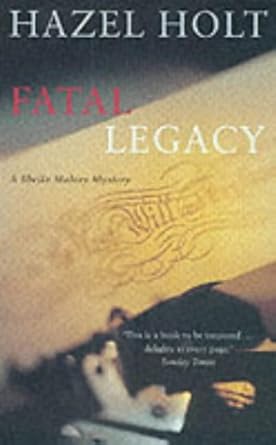

Instead, I'll finish off with a few comments on another favourite Hazel Holt book of mine, which is Fatal Legacy. In this book, Sheila is made Literary Executive to her friend Beth, a famous novelist who dies early in the book. The parallel with Hazel Holt's own experience as Literary Executive to her friend Barbara Pym is obvious. The background knowledge naturally makes this book especially successful and readable, but I think I can safely say that the plot, and Sheila's reluctant discoveries about her dead friend's life, are purely invention and in no way related to Barbara Pym. I'll leave you to find out more for yourself by reading the book.

And may I suggest that you might like to read my own books? Here they are, in case you don't know.


Belfast Girls 


Danger Danger


Angel in Flight: the First Angel Murphy Thriller


The Seanachie: Tales of Old Seamus


Lady Molly And The Snapper


And finally, my new release, Angel in Belfast: the 2nd Angel Murphy Thriller about the feisty young Belfast girl!


Why not try them?

Goodbye and God Bless! See you soon!


Thursday, 10 October 2013

O'Bryan's back!


This blog post is a little different from my usual. Laurence O'Bryan, an excellent Irish writer whose first books, The Istanbul Puzzle and The Jerusalem Puzzle have both been bestsellers, is bringing out the third in his series, The Manhattan Puzzle, today. You heard it here first, folks, as the man said. So Laurence is guesting on my blog today – something I don't usually do, but, hey, why not be different occasionally? I should really be posting an old favourire, and I intended this to be the very enjoyable Hazel Holt, but that will have to be next time. So here's a new writer, instead. (I blogged about him a while ago, if you remember?) So take it away, Larry!


The Themes of The Manhattan Puzzle
By Laurence O’Bryan

What has been hidden in Manhattan by the most powerful people on earth?
What would you do to a Manhattan banker who treated ordinary people like slaves?
What magic is buried under Manhattan that allows it to rise again from anything the world throws at it?


These are the themes of The Manhattan Puzzle. The story sees Sean and Isabel (my characters from The Istanbul Puzzle and The Jerusalem Puzzle) reunited in Manhattan at the headquarters of one of the world’s largest banks, BXH. There’s been some grisly murders, and now the plot takes a new twist. The contents of the book they found in Istanbul are revealed.
My personal journey with this story grew out of my disgust at the financial crisis that has brought many so low. I am interested in the myths and the beliefs of those who value money above everything.
But The Manhattan Puzzle is about other things too. For instance, what would you do if your partner didn’t come home one night? And what would you think if the police turned up at your door the next day looking for him?
Relationships are under stress everywhere, because of the demands placed on us by our jobs, but few of us will face what Isabel has to face when Sean goes missing.
There is violence from the start in The Manhattan Puzzle too, but the opening has a woman inflicting it on a man. I am tired of reading about men inflicting sexual violence on women. I think it’s time for the handcuffs to swop wrists. And they certainly do in The Manhattan Puzzle. You can download the first chapter here as a pdf. 
But don’t get me wrong. I love Manhattan. It’s a city in a snow globe of dollar bills. So look in your bookstore and on your E-readers and order it too, if you want.
To order The Manhattan Puzzle click here.
Or to visit my website click here.
And thanks for reading this and for buying The Manhattan Puzzle, if you do. I hope you find it entertaining and the themes interesting.


Thanks , Larry! And if you're checking out Laurence O'Bryan's books on Amazon, you might like to have a look at mine too. (Belfast Girls, Danger Danger, Angel in Flight, Angel in Belfast, The Seanachie: Tales of Old Seamus and my YA book, Lady Molly & The Snapper. Lots there to enjoy!)

God Bless and see you soon!

Thursday, 19 September 2013

The fantastic Frank McGrath CUTs to the chase!


It's the turn of one my 'new discoveries' to feature on the blog. Last time I wrote about an 'old favourite', Modesty Blaise. This time I have a really exciting new writer for you.

More than three years ago I came across a great writer on the Harper Collins slush pile site, Authonomy – Frank McGrath from Dublin. His book was at that time called Artistic Licence (a very clever name, I thought – cleverness in a title always appeals to me) and I was hugely impressed by it. I particularly liked his cop character, Jack Grogan. Just my sort of flawed, independent hero.

I became a 'virtual' friend of Frank, but alas he disappeared from Authonomy when (no surprise) his book was picked up by an established agent, and he was told to pull it and make a ton of suggested edits. It seemed like a great step forward for him.

But I was annoyed at the suggested edits, particularly the criticisms of the lead character – I thought the book was great as it was. And as several years went on, and I reached the top 5 on Authonomy; was offered a publishing deal for Belfast Girls by Night Publishing; and went on to sell well over 20,000 of that particular book (and still counting), I seriously wondered if Frank was doing the right thing.

In late July this year his book was finally published, and I humbly take it all back. This was a very good book – now it's a great one.


Frank McGrath now ranks among my really favourite authors, and I'm looking forward eagerly to his next book.  It's not many of the new writers I can say that about, I'll admit, but Frank stands out, as he did on Authonomy, head and shoulders above most of the rest.

Apparently one of the major editing suggestions made was that he should split the book into two, with a separate story about the villain . This must have been extremely difficult since, as I remember it, in the first version the two characters and their stories were intricately linked.


Frank tells me,

 'The key problem I had was to separate the bad boy character at the start of the old "Artistic Licence" into his own story…. which is done. Here's the pitch:
"BAD

Meet Daniel Hennessy: artist, mental patient, sociopath. 
Released on compassionate grounds due to terminal illness, Danny has one last mission to perform."

That should go on Amazon on a few months.'
Sounds fascinating, Frank.

But to return to CUT (another very clever title, as you'll see when you read it).

The blurb on Amazon is this:

A savage killing. A girl missing. A clock ticking.

A cop who sees the world differently.
Detective Jack Grogan investigates the disappearance of the Chinese Trade Minister’s 15 year old daughter, following the brutal murder of her bodyguard.
He soon discovers that Lynsey Tao is a pawn in a game where no one can be trusted and nothing is what it seems.

Sounds good, right?

And my own review reads:


I've just finished reading CUT by Frank McGrath and I'm still breathless.

This, as other reviewers have said, is a fast moving book which grips you by the throat from the first page and refuses to let you go. To me it was like reading my first Ruth Rendell, Ian Rankin, or Sara Paretsky. I knew at once I had found a new writer whose books I was going to love right through everything he wrote. A book full of grit, focussing on the dark side, but with characters to love and rejoice in, and with the sort of depth and philosophy which can't be forgotten.

Superintendent Jack Grogan is a flawed but fascinating character, one I'm determined there should be more of. Jack makes his own rules, and this naturally leads him into trouble, but his brilliance carries him through bad times as well as good. His life hasn't been easy. His separation from his wife, the death of his young son - these are the sort of things, together with Jack's subtly conveyed feelings about them, which draw us ever deeper into the book.

McGrath's style is an added bonus. His images and descriptions bring his scenes alive. For instance, 'The marble fireplace was big enough for Santa to enter and exit without having to crouch.' (This at Christmas time, so especially striking.)

Like all good detective stories, CUT twists and turns, with suspect after suspect emerging, and the ending (which will shock you) has not one but three twists, following fast on each other's heels.

Frank McGrath, we want more! When's the next Jack Grogan book coming?

Really highly recommended.

As you can see, I'm pushing this book as hard as I can!
You can buy CUT on Amazon (for only 77p / 99c) at: 

And hey, let's not forget, you can buy my own books at these links:


Belfast Girls 


Danger Danger


Angel in Flight: the First Angel Murphy Thriller


The Seanachie: Tales of Old Seamus


Lady Molly And The Snapper


And finally, my new release, Angel in Belfast: the 2nd Angel Murphy Thriller about the feisty young Belfast girl!


Why not try them?

Goodbye and God Bless! See you soon!


Tuesday, 16 July 2013

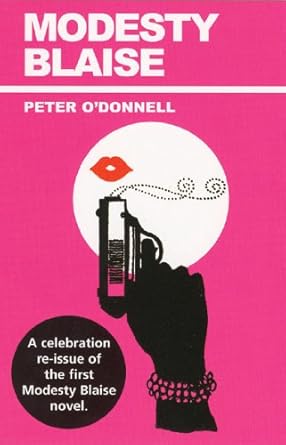
The first of the feisty women – Modesty Blaise (created by Peter O'Donnell)


Modesty Blaise has been a heroine of mine for quite a few years. I first came across her as a young teenager. At that stage in my life most of the books I read came from the Public Library about half a mile from our house down the Oldpark Road. I used to walk there nearly every Saturday with my pile of recently read books under one arm, and return an hour or two later with a fresh batch to keep me going for another week.

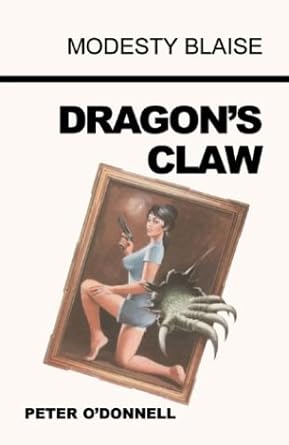
On one of these excursions I came across a book called Dragon's Claw, which was about the adventures of a young woman called Modesty Blaise, whom I'd never heard of before. I took it home and read it with great enjoyment, and then searched vainly for more Modesty Blaise books, not only in the Library but in the local bookshops. Belfast was well provided with good bookshops in those days, but none of them stocked Modesty Blaise.

As time went on I gave up trying, although some episodes in the book remained burnt into my brain – Modesty rescuing Luke Fletcher, adrift in a rowing boat,  while sailing a yacht single handed in the Tasman Sea, and keeping him from falling out of his bunk during a fierce storm by lying beside him body to body; and her later escape from an island prison using hang gliders.

These were pictures still in my head years later when I began buying books through the Internet, and it suddenly occurred to me to check if any Modesty Blaise books were available there. I first of all bought one or two second hand, then discovered that they'd been republished not long before and were available at not too high a price. I put them on my wish list, was bought a lot more as presents, and kept adding to my collection. I'm now in the pleasant position of owning about two thirds of them, to read and enjoy re-reading; but with several which I still don't own and which I can look forward to as treats sometime before too long.

Some of them are also on Kindle, but at the usual high price of established publishers – very silly, isn't it?


Modesty Blaise grows as a character as the books continue to flow. Peter O'Donnell, the author, was a very clever man and an excellent writer. Willie Garvin, Modesty's friend and assistant, is an amazing character in himself, and there's a range of minor but recurring characters all interesting and full of life.

Modesty is an expert in unarmed combat. Her feet are particularly strong for kicking, and she and Willie practice together regularly. Willie is very expert with a knife, while Modesty prefers a gun, but more often uses a small hand held wooden weapon called a kongo.

But Willie is much more than a simple minded thug. He has no formal education, but picks up information readily and retains it. He knows the Book of Psalms off by heart and quotes it often. He takes great pleasure in stumping Modesty by using a word he's sure she won't have heard of, such as pandiculation or oenanthic. (Look them up for yourselves – I had to!) The game they play with these words requires Modesty in turn to use the word in conversation without having seemed to look it up in the meantime. If, like me, you love words, this all adds to the enjoyment.

But the main attraction of these books lies in the action. Modesty and Willie are both expert at coming up with ideas for a 'con' (I saw one of their ideas used in an episode of Hustle not long ago!), which adds to the interest, but their cleverness  in action and their physical skill (which gets them out of many a tight corner) are the high notes of the stories.


Modesty began life as a war orphan wandering from one Displaced Persons camp to another at the age of around seven – she can't remember further back, probably mercifully. She doesn't know her name or her accurate age. She befriends an elderly academic who gives her a name and teaches her what he can in lieu of a formal education, while she in turn looks out for him in all the practical ways necessarily for their survival.

She walks barefoot over the Middle East until her teenage years and eventually emerges in Tangiers, after the recent death of her elderly friend. There she works in a Casino, becomes a force to be reckoned with in the gang which runs it, and eventually takes over the gang  when its leader is murdered. Going from strength to strength, she runs a criminal organisation known as the Network; until at the age of twenty-six she retires with a sufficient fortune to live a life of leisure.

 Instead, she and Willie Garvin promptly get sucked into working for the British Secret Service by its chief Sir Gerald Tarrant – and this is where the first book, simply called Modesty Blaise, begins.

As must be clear by now, I love these books. In the eighties I wrote my first grown up book, a thriller written very much in the style of the times. When I got it out recently I decided that it had too much potential to be left mouldering in a drawer for another twenty years, but that it needed a thorough overhaul to bring it up to date.

And one of the main things I did was to change the rather wimpy heroine to someone much more like Modesty Blaise. I tried not to steal anything, but simply to create a strong woman who wouldn't let herself be pushed around and who was prepared to tackle any villains who came along – and the result was Angel in Flight, the first of my series of books about Angeline, or Angel, Murphy, the feisty Belfast girl.

And now the second of the Angel Murphy Thrillers, Angel in Belfast, is out. I can promise at least two more which I've been thinking about – but who knows where it will stop? Thank you, Peter O'Donnell and Modesty Blaise, for your inspiration. Apparently the Modesty Blaise books, which sprang out of a popular strip cartoon, have sold in their millions. Wouldn't it be nice if the same thing happened to Angel Murphy?

You can buy my books at these links:


Belfast Girls 


Danger Danger


Angel in Flight: the First Angel Murphy Thriller


The Seanachie: Tales of Old Seamus


Lady Molly And The Snapper


And finally, my new release, Angel in Belfast: the 2nd Angel Murphy Thriller about the feisty young Belfast girl!


Why not try them?

Goodbye and God Bless! See you soon!